
RTL Design Fundamentals
Express digital circuits in SystemVerilog. Work through types, widths, signedness, combinational and sequential logic, modules, parameters and generate constructs, then verify boundaries and failures with independent testbenches. Finish by composing a periodic-pulse accumulator and recording reproducible execution evidence.
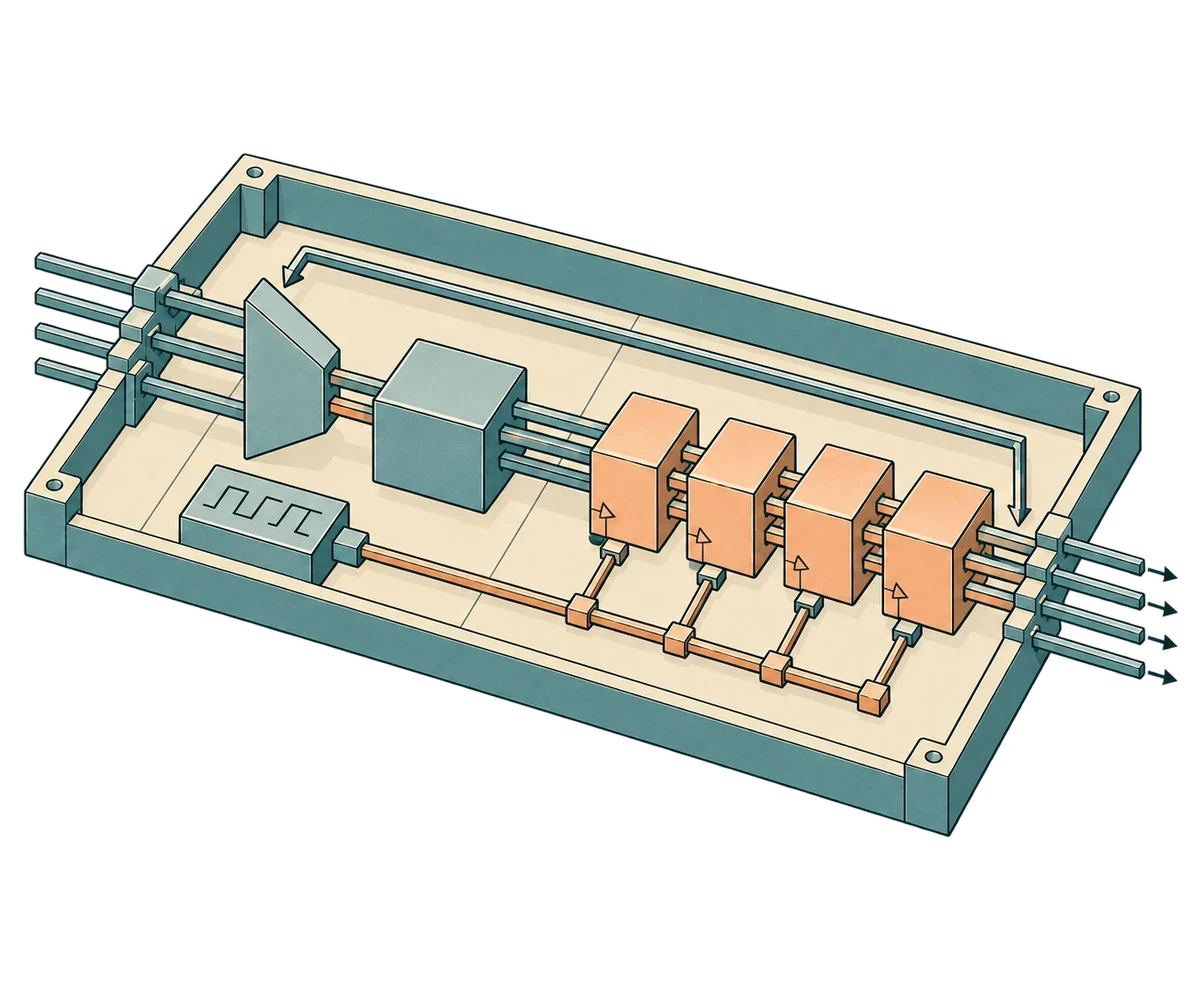
What you will learn
- Specify each signal’s width, signedness, driver, valid time and reset value.
- Write complete combinational assignments separately from clocked state updates.
- Build static structures with parameters and generate, and test boundary configurations.
- Compose modules using named port connections and functions.
- Write race-free stimulus and independent reference models in testbenches.
- Distinguish compile, simulation, synthesis and DDS execution evidence.
Before you begin
These browser exercises use educational models; they do not compile or run HDL. To run the supplied source separately, follow the Digital Design Studio guide for your operating system and sign in when the operation requires it.
Installation and first launch ↗ · Downloads ↗Curriculum
- RTL and module contracts
- RTL: describing concurrent circuitsConcept
Separate software execution order from parallel hardware structure and specify state, next state and observation times.
- Signals and ports: a contract for width, direction and timeConcept
Read interfaces and distinguish the checking criteria for combinational and state outputs.
- Modules, ports and instances: connections as contractsConcept
Compose combinational modules using named connections while checking single drivers and hierarchy boundaries.
- Check: combinational and stored outputsCheck
Distinguish when inputs change from when a register is observed.
- Types, widths, signedness and expressions
- logic, wire, X/Z and explicit bit widthsConcept
Understand why a type declaration does not determine storage and verify literals, comparisons, extensions and unknown values.
- Vector indexing, bit order and signednessConcept
Separate bit numbering, serial transmission order and arithmetic interpretation when reading datapaths.
- Widths of slices, concatenations and replicationsConcept
Build datapaths by calculating concatenated widths and the conditions for preserving values.
- Two's complement, sign extension and overflowConcept
Use equations and counterexamples to distinguish signed bit-pattern interpretation from addition overflow.
- Check: range and explicit extensionCheck
Check the input and output widths of an adder together.
- Complete combinational RTL and verification
- Combinational RTL and complete assignmentsConcept
Express the same function with a conditional operator and always_comb, and find omissions that infer latches.
- Encoders and priority: choosing one of several requestsConcept
Distinguish the input assumption of a one-hot encoder from a priority encoder's valid and selection outputs.
- MUX verification: exhaustive tests and propertiesConcept
Check combinational input coverage separately from storage behavior, and minimize counterexamples.
- Design check: selection equivalence and observation timingCheck
Distinguish checks covered by a truth table from those requiring clock observations.
- State, assignments and reset priority
- Flip-flops, enable and control priorityConcept
Define hold, load and reset through next-state equations and avoid unintended clock gating.
- Nonblocking assignments and simultaneous state updatesConcept
Separate old and next values to interpret pipeline and counter RTL correctly.
- Modulo and saturating counters, and terminal pulsesConcept
Specify maximum-value handling and the exact cycle of the terminal-count signal.
- Lab: verify counter reset, wraparound and invariantsLab
Compare every rising-edge state with a reference model and separate the effects of initialization, reset and width.
- Design check: boundaries of width, priority and wraparoundCheck
Use a specified state-transition contract to reason about boundaries and simultaneous controls.
- Parameters and static structure generation
- parameter, localparam, $clog2 and boundary configurationsConcept
Separate run-time inputs from static configuration and design counter widths and termination for N=1 and non-power-of-two values.
- generate: building static circuits with loopsConcept
Use genvar and generate-if to create named circuit instances and check bus lane placement.
- function automatic and reusable expressionsConcept
Write functions that consume no simulation time and check return width, signedness and reference-model independence.
- Check: N=1 and bit widthCheck
Separate a declaration that guarantees minimum width from a counter’s actual number of states.
- Testbenches and independent verification
- Waveform sampling times and causalityConcept
Read waveforms by separating combinational settling, clock capture and event order.
- Lab: a testbench that reports its own failuresLab
Separate DUT, stimulus, reference model and checks, then test reset, enable and wraparound at race-free observation times.
- Verification plans, coverage and independent reference modelsConcept
Distinguish passing tests from satisfying the specification, and link boundaries, crossed conditions and minimal counterexamples to a verification plan.
- Counter debugging and minimal counterexamplesConcept
Design short tests that distinguish reset, enable and wrap-boundary errors.
- Check: reference models and racesCheck
Choose expectations independent of the DUT and a post-edge checking time.
- Module composition and integrated lab
- State machines: separating state, transitions and outputsConcept
Build an FSM from a specification table and compare Moore/Mealy outputs, illegal states and request policies.
- Capstone: an overlapping 101 pattern detectorConcept
Apply state minimization, input validity, registered outputs and independent reference checking in one design.
- Ready/valid and a one-entry elastic bufferConcept
Design lossless, duplicate-free transfers and simultaneous input/output in a datapath that can stall.
- Multiply-add pipelines and data alignmentConcept
Split arithmetic at register boundaries and keep data, valid, and side operands aligned to the same transaction.
- Integrated lab: periodic pulses and an enabled accumulatorLab
Specify inter-module transfers using previous values and compare enable stalls, consecutive pulses and simultaneous reset against a reference model.
- Tool diagnostics and the scope of results
- Setup, hold and timing budgetsConcept
Separate maximum and minimum path delays and calculate hold requirements independently of clock frequency.
- Clock-domain boundaries and metastabilityConcept
Understand the limits of a two-stage synchronizer and distinguish single-bit levels, short pulses and multibit transfers.
- Compile, lint and synthesis: what diagnostics establishConcept
Fix the source list, top module and language mode and distinguish syntax errors, width warnings, latches and functional verification.
- Execution records and continuing into DDS practiceConcept
Bundle source, inputs, expected values, failure conditions and tool versions into reproducible practice evidence.
- Final check: functional passes and execution evidenceCheck
Distinguish local tool results from acceptance evidence for free DDS practice.